Affidavits of heirship without the guesswork
Get your affidavit of heirship right on the first try with the Heirsy Kit, which includes the Affidavit Builder, Heirship Guide, and Video Course.
Just $197

Recorded or Refunded. If the county won’t record your affidavit, you get your money back.
Read more →What is an affidavit of heirship?
An affidavit of heirship is a sworn statement that shows who inherits a person’s property after they die. Families use it when there is no will, or when the will was never probated.
Most families use an affidavit of heirship to clear the title to a house or land so they can sell it, refinance it, or pass it on. It is signed by one heir and two witnesses before a notary. Once recorded in the county where the property is located, it becomes proof of heirship, all without going to court.
Is an affidavit of heirship right for you?
Answer three simple questions to learn if an heirship affidavit might be right for situations like yours.
Question 1 of 3
Did the person who died leave behind real estate in Texas?
A house, land, or other real estate.
The Heirsy Kit
The Heirsy Kit takes you from a blank form to an affidavit that is ready to sign and record. It includes an online tool to build your affidavit, a written guide to answer common questions, and a video course to walk you through the process step by step. The Heirsy Kit has everything you need to prepare your affidavit quickly and with confidence.
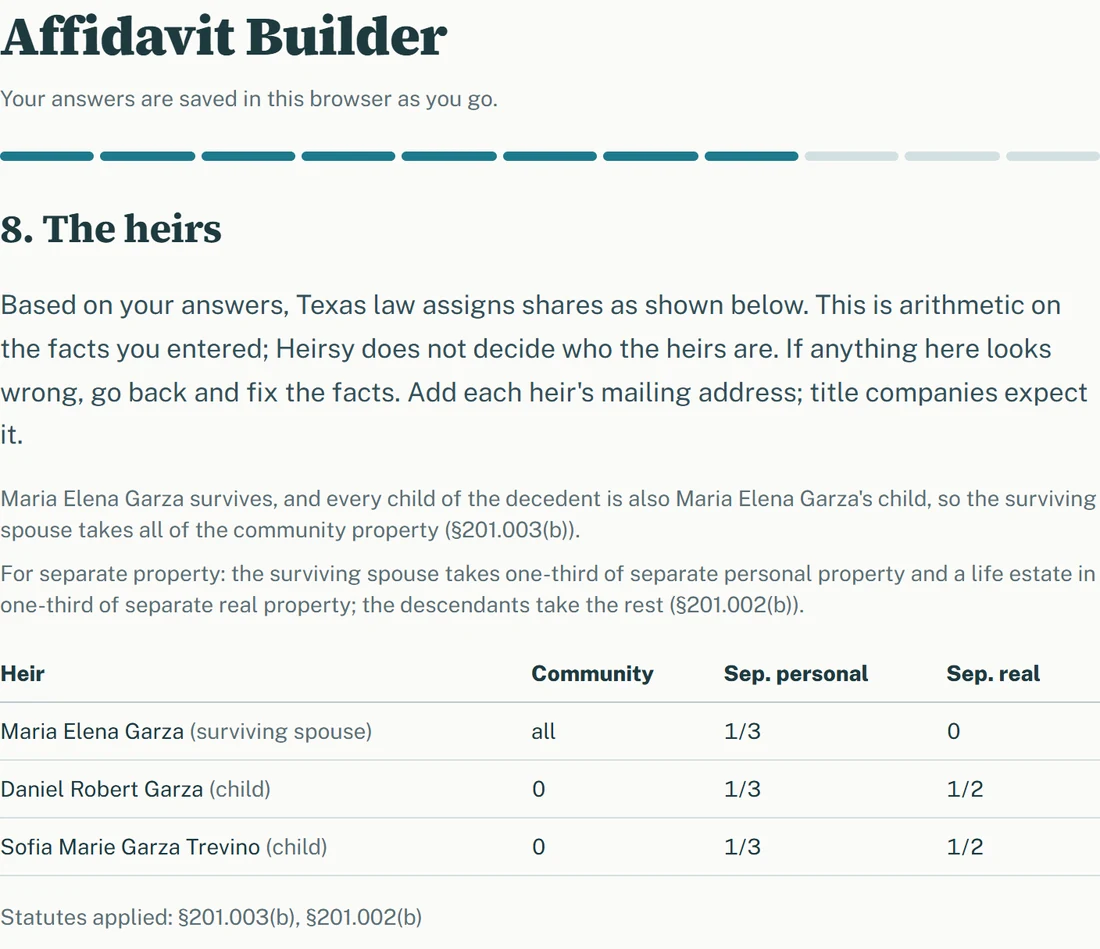
The Affidavit Builder
You provide information about the family. The Affidavit Builder puts the document together for you, tells you if anything is missing, and calculates what each heir inherits.
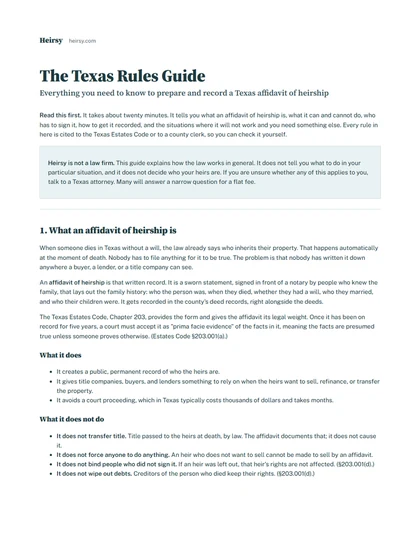
The Heirship Guide
A clear and direct explanation of what the affidavit does, what it does not do, and how to avoid common pitfalls.
The Video Course
A video series that walks you through how to use the Affidavit Builder, to make your experience as smooth and stress-free as possible.
Plus five bonus guides
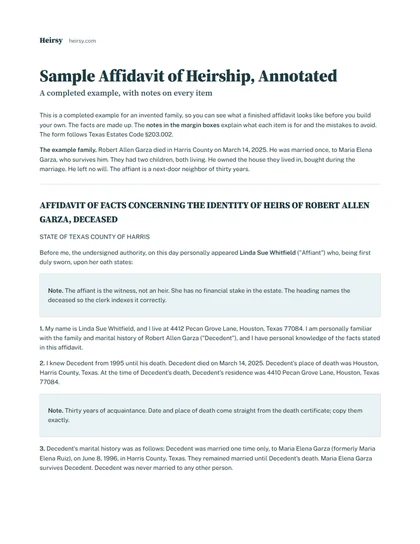 Annotated sample affidavitWhat is it supposed to look like?
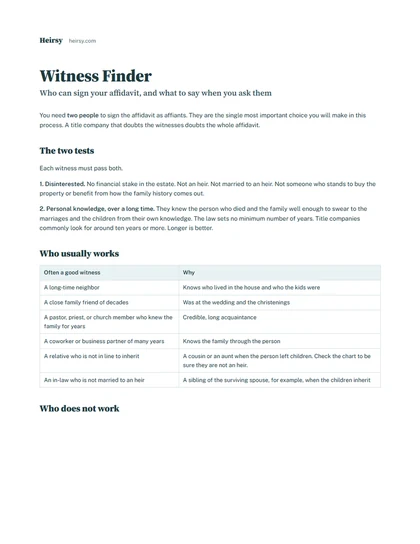 Witness FinderWho can sign, and what do I say to them?
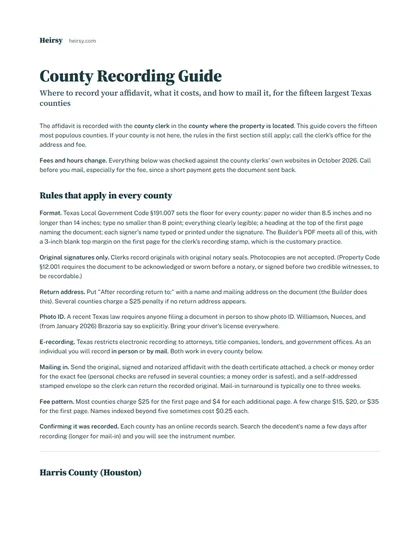 County Recording Guide, all 254 Texas countiesWhere do I take it, what does it cost, can I mail it?
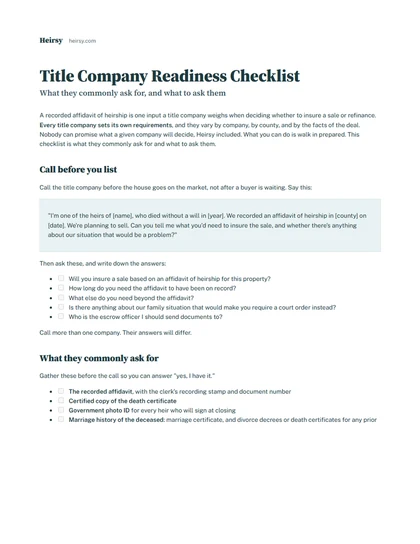 Title Company Readiness ChecklistWhat will they ask me for?
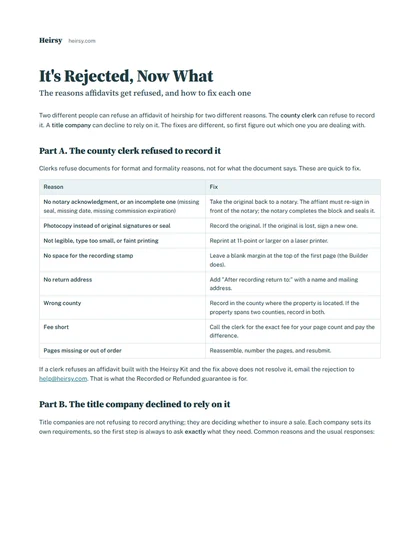 It’s Rejected, Now WhatThe clerk or the title company said no. What do I do?
Using the Kit
Four steps, start to finish.
- 1.
Answer questions
Tell us about your family, your witnesses, and the property.
- 2.
Review the affidavit
The Affidavit Builder puts your answers into the form.
- 3.
Sign before a notary
When your affidavit is ready, sign it in front of a notary.
- 4.
Record at the county
Take or mail your affidavit to the county where the property is.
Our guarantee to you
Recorded or Refunded.
If the county won’t record your affidavit, you get your money back.
This covers any affidavit you made with our Affidavit Builder. Email us the clerk’s rejection. If the problem is with the form of the affidavit, we refund your $197. If it was signed, witnessed and notarized and the county still won’t record it, that’s on us.
Two things are outside the guarantee, because they are outside our control. The Affidavit Builder fills the form with facts you provide: names, dates, the property description, and family relationships as you entered them. A rejection based on information you provided is not covered. The guarantee is also limited to recordings by the county clerk. It does not guarantee that a title company will accept an affidavit, because each title company sets its own requirements and those requirements change over time.
Read the refund policy →Get started today for just $197.
The Heirsy Kit
$197
One payment. No subscription. Start today.
- The Affidavit Builder fills in the form from your answers
- It works out each heir’s share and shows you how
- The Witness Finder tells you who can sign
- You get recording steps for your county
- Recorded or Refunded
Texas attorneys commonly charge $750 to $2,000 for an affidavit of heirship.

Who we are
Heirsy grew out of a Texas service business that prepared affidavits of heirship for families and investors, one at a time, for a fee. We saw the same questions and the same mistakes, over and over. Most of those families could have done it themselves with the right instructions, which was our inspiration to create Heirsy.
We are not a law firm, and we do not give legal advice. But Texas law lays out formulas for creating affidavits of heirship and determining what heirs inherit. Those formulas are at the core of our Affidavit Builder. We unpack them in our Heirship Guide. And we talk about them in our Video Course.
Our mission at Heirsy is to make the affidavit of heirship process more accessible to Texas families, so fewer properties are needlessly left in legal jeopardy.
Common questions.
Can I legally do this myself in Texas?
Isn't the form free?
What if there's a will?
Who has to sign?
Do all the heirs have to agree?
How long does it take?
Will a title company accept it?
Why not just pay a lawyer?
What if the clerk won't record it?
Is this legal advice?
What about other states?
Is there a Spanish version?
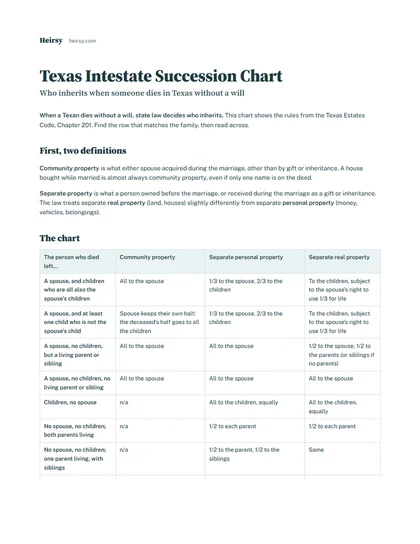
Free Texas Intestate Succession Chart
Who inherits in Texas when there is no will? See for yourself in this easy-to-follow infographic.